 Volvenix
DataSynth vs DeepBrain Chain
AI-enhanced independent comparison — features, pros, cons, pricing and rankings.
 ChatGPT
  Claude
  Gemini
  Midjourney
  DALL-E
  Stable Diffusion
  Notion AI
  Canva
Canva  Grammarly
  GitHub Copilot
  ElevenLabs
  Perplexity
  Runway
  Synthesia
  Fireflies.ai
  Hugging Face Hub
| Dimension | DataSynth | DeepBrain Chain |
|---|---|---|
| Accuracy & Reliability | ||
| Ease of Use | ||
| Features & Capability | ||
| Value for Money | ||
| Performance & Speed | ||
| Popularity & Adoption |
Who each tool serves best — and when to pick the other one.
This tool fits if you need to generate synthetic data for AI training while ensuring privacy compliance.
- You need to create synthetic datasets for AI training.
- You want to ensure compliance with data privacy regulations.
- Your team requires customizable data generation options.
Skip this tool if you require real-time data or have a limited budget for data solutions.
- You need real-time data generation capabilities.
- Free-tier limits are a blocker for your projects.
- You require extensive support for integrations.
The ability to generate high-quality synthetic data while ensuring privacy compliance.
Ideal for enterprises and developers seeking secure, cost-effective AI training solutions.
- You need a secure environment for AI model training.
- You want to reduce computational expenses significantly.
- Your team requires scalable AI training solutions.
Not suitable for small teams or individuals looking for straightforward, traditional AI training platforms.
- You need a simple, traditional AI training platform.
- Free-tier limits are a blocker for your projects.
- You require immediate support and guidance.
The ability to leverage blockchain for decentralized AI training.
Each tool's marketing-listed features. Where a feature appears under one tool but not the other, it usually reflects how the vendor describes their product — not a definitive capability gap.
- Custom Data Generation — Tailor datasets to specific needs.
- Privacy Compliance — Ensures adherence to data regulations.
- Collaborative features — Support for team-based data projects.
- Decentralized AI Training — Train AI models on distributed, blockchain-powered infrastructure
- Privacy-Preserving Computation — Data privacy via blockchain and secure computation nodes
- Token-Based Resource Marketplace — Incentivizes sharing of computing resources via DBC token
- AI Inference Services — Run inference workloads on decentralized nodes
- Customizable Node Deployment — Deploy and manage AI nodes as needed
- High-quality synthetic data generation
- Privacy compliance focus
- Customizable data options
- User-friendly interface
- Strong support for data scientists
- Innovative use of blockchain for AI training
- Strong focus on data security and privacy
- Potential for significant cost savings
- Learning curve for new users
- Pricing may be a barrier
- Complexity of blockchain technology
- Limited support for smaller teams
- Training AI models with synthetic data
- Testing machine learning algorithms
- Data analysis without privacy risks
- Creating datasets for research purposes
- Enterprise-scale AI model training
- Privacy-sensitive data processing
- Cost-optimized distributed AI workloads
- Blockchain-based AI resource sharing
- Secure AI inference for regulated industries
Where each tool runs — web, mobile, desktop, browser extension, API.
The underlying AI models each tool runs on. Model details show on hover.
No models confirmed.
Natural languages each tool generates and understands. Primary languages are listed first.
What each tool can accept (input) and produce (output) — text, image, audio, video, code.
DataSynth offers a paid subscription model with various pricing tiers for different user needs.
-
Pro
popular
$20.00/mo -
Team
$30.00/mo
Enterprise pricing model focused on large-scale deployments, specific costs not publicly listed.
—
Regulatory frameworks each tool claims compliance with (HIPAA, SOC 2, GDPR, etc.).
None listed.
Vendor-published numbers each tool highlights — usage scale, breadth, and operational stats. Different tools track different metrics, so direct row-by-row comparison usually isn't meaningful.
- Synthetic records generated Millions
- Privacy compliance GDPR-ready
- Training Cost Reduction Up to 70%
- Nodes in Network 2000+
How you can reach support — email, live chat, phone, community, docs.
- Email primary
- Documentation primary visit ↗
How each tool is classified in the Volvenix catalog.
These vocabulary domains are managed in our catalog but not yet exposed at the tool level. We're tracking them for future expansion of this comparison.
- Encryption Types — AES-256, ChaCha20, RSA-2048, and similar at-rest/in-transit cipher families.
- Encryption Contexts — where encryption is applied (data at rest, in transit, end-to-end).
- Plan-tier Model Mapping — which AI models are available on which pricing tier (currently only the model list is tracked, not the per-plan availability).

- What is this tool?
- DataSynth generates synthetic datasets for AI training while ensuring privacy.
- How much does it cost?
- Pricing starts at $20 per month for the Pro plan.
- Does it have a free plan?
- No, DataSynth does not offer a free plan.
- What integrations does it support?
- Integrations are not explicitly listed on the website.
- Who is it best for?
- DataSynth is ideal for data scientists and engineers.
- What is this tool?
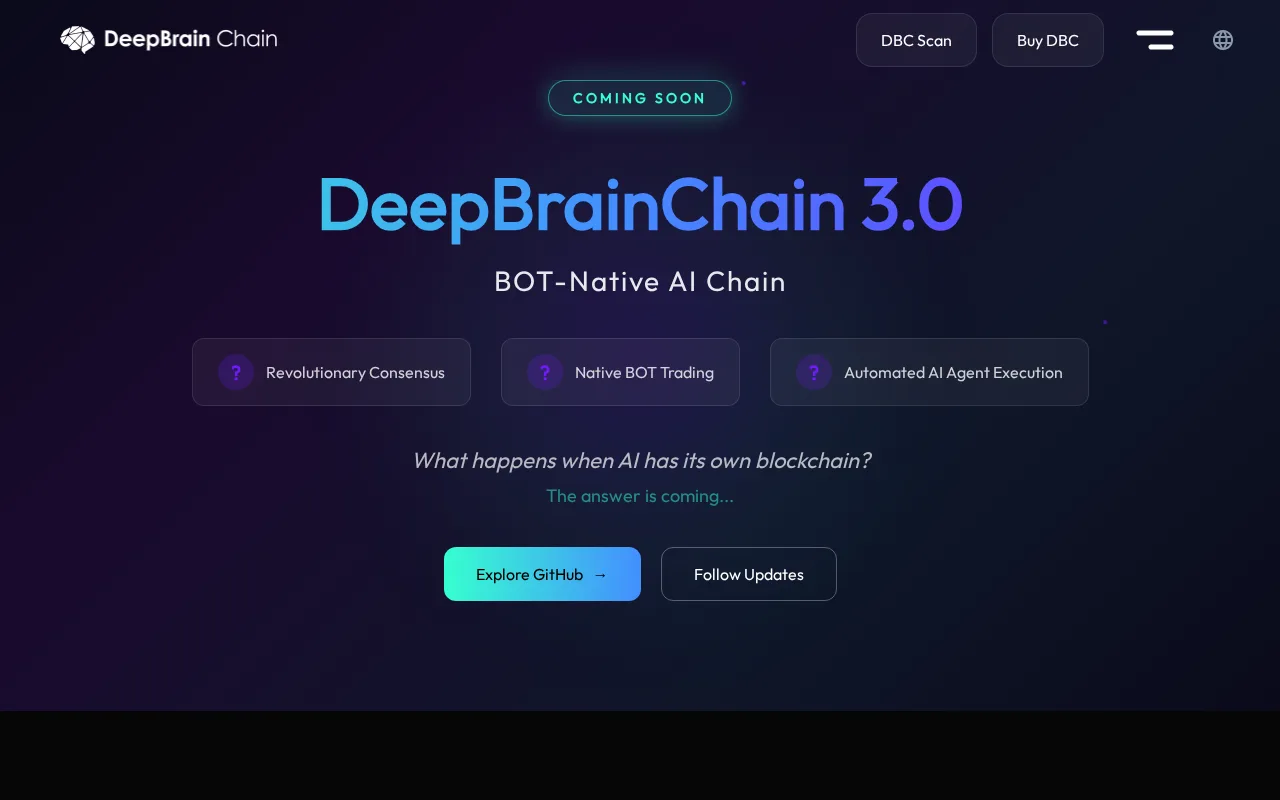
- DeepBrain Chain is a decentralized AI computing platform using blockchain to provide cost-effective, privacy-focused AI training and inference services.
- How much does it cost?
- Pricing is enterprise-based and determined by resource usage and custom agreements; no public pricing is available.
- Does it have a free plan?
- No, DeepBrain Chain does not offer a free plan.
- What integrations does it support?
- No public information on third-party integrations is available.
- Who is it best for?
- It is best for enterprises and developers needing scalable, privacy-focused AI training infrastructure.
| Info | DataSynth | DeepBrain Chain |
|---|---|---|
| Pricing | Paid | Enterprise |
| Category | Data Engineering, MLOps & Pipelines | Data Engineering, MLOps & Pipelines |
| Deployment | Cloud | Cloud |
| Free Plan | ✗ | ✗ |
| AI Agent | ✗ | ✗ |
 Dataiku
 Azure Machine Learning
 Mostly AI
 FeatureByte
 Tamr
Tamr ZenML
ZenML Obviously AI
 Synthesized
DeepBrain Chain and DataSynth both have an overall score of 5.2/10 but differ in pricing and target use cases. DeepBrain Chain offers enterprise-level pricing, suggesting a focus on large-scale or corporate clients, while DataSynth uses a paid pricing model that may cater to a broader range of users. Feature-wise, DeepBrain Chain is typically oriented towards AI computing and blockchain integration, whereas DataSynth specializes in synthetic data generation for testing and development purposes.
ⓘ How Volvenix scores work
Scores are computed by Volvenix — not supplied by the vendors, and not third-party benchmark results. Each 0–10 dimension (Overall, Features, Usability, Support, Pricing) is a directional estimate aggregated from catalog signals — editorial cataloguing, content depth, engagement, and provider-reputation indicators — so treat them as a starting point, not a lab result.
Confidence reflects how complete the underlying data is for both tools; lower confidence means fewer signals were available, not a worse tool. We never accept payment for rankings or scores. More about how Volvenix works →