 Volvenix
Jumio Identity Verification vs IDnow AutoIdent
AI-enhanced independent comparison — features, pros, cons, pricing and rankings.
 ChatGPT
  Claude
  Gemini
  Midjourney
  DALL-E
  Stable Diffusion
  Notion AI
  Canva
Canva  Grammarly
  GitHub Copilot
  ElevenLabs
  Perplexity
  Runway
  Synthesia
  Fireflies.ai
  Hugging Face Hub

Who each tool serves best — and when to pick the other one.
Enterprises and regulated businesses requiring automated, compliant identity verification to prevent fraud.
- You need to verify customer identities with government-issued IDs and biometrics
- You want to reduce fraud risk with automated liveness and face matching
- Your team requires compliance with global KYC and AML regulations
Small startups or businesses with limited budgets or simple verification needs may find it too complex or costly.
- You need a low-cost or free identity verification solution
- Free-tier limits are a blocker for your volume or feature needs
- You require a simple plug-and-play tool without complex integration
Accuracy and compliance in identity verification with biometric and document authentication.
Enterprises and regulated businesses requiring automated, compliant identity verification at scale.
- You need to automate KYC/AML identity verification with high accuracy and compliance.
- You want a hybrid AI and human review process for fraud prevention and reliability.
- Your team requires support for multiple ID types and global identity verification.
Small startups or teams without compliance needs or those seeking fully self-service, low-cost solutions.
- You need a low-cost, fully self-service identity verification without human involvement.
- Free-tier limits are a blocker for your small-scale or infrequent verification needs.
- You require transparent, publicly available pricing and simple integration.
The balance of automation with human oversight for secure, compliant identity verification.
A canonical comparison across capabilities common to this category. Vendor-specific extras appear below in "Highlighted Features".
| Capability | Jumio Identity Verification | IDnow AutoIdent |
|---|---|---|
|
Free Tier Available
Usable without payment (with usage limits)
|
✓ | ✓ |
Each tool's marketing-listed features. Where a feature appears under one tool but not the other, it usually reflects how the vendor describes their product — not a definitive capability gap.
- ID Document Verification — Authenticates government-issued IDs globally
- Biometric Facial Recognition — Matches user selfie to ID photo with liveness checks
- Liveness Detection — Detects spoofing attempts in real time
- Compliance Reporting — Supports KYC and AML regulatory compliance
- Mobile SDK — Integrates verification into mobile apps
- Automated Video Identification — Uses video to verify identity documents and face
- AI-based Face Recognition — Matches live face with ID photo for verification
- Multi-ID Type Support — Supports passports, ID cards, and driver’s licenses
- Compliance & Fraud Detection — Built-in checks for KYC/AML compliance and fraud
- Human-in-the-loop Verification — Manual review for edge cases and increased accuracy
- Accurate ID document verification with biometric matching
- Supports a wide range of global identity documents
- Real-time liveness detection to prevent spoofing attacks
- Compliant with major KYC and AML regulations
- Scalable cloud-based platform for enterprise needs
- Hybrid AI and human verification for accuracy
- Global ID document support
- Strong compliance focus
- Fraud prevention capabilities
- Scalable for enterprise use
- Pricing is not transparent and requires sales contact
- Integration can be complex for smaller teams
- No public API documentation available
- Pricing details are not publicly available
- Integration can be complex for smaller teams
- No public API documentation available
- Customer onboarding for financial services
- Fraud prevention in e-commerce
- Age verification for regulated products
- Access control for secure facilities
- Compliance with KYC/AML regulations
- Customer onboarding for banks and fintech
- Age verification for regulated industries
- Remote identity verification for online services
- KYC/AML compliance automation
- Fraud prevention in digital transactions
Natural languages each tool generates and understands. Primary languages are listed first.
What each tool can accept (input) and produce (output) — text, image, audio, video, code.
Offers a freemium model with pay-as-you-go pricing; detailed costs require contacting sales.
-
Free
Free
Offers a freemium model with basic features free; advanced capabilities and volume pricing require contact with sales.
-
Free
Free
Regulatory frameworks each tool claims compliance with (HIPAA, SOC 2, GDPR, etc.).
None listed.
Vendor-published numbers each tool highlights — usage scale, breadth, and operational stats. Different tools track different metrics, so direct row-by-row comparison usually isn't meaningful.
No metrics published.
- Verification Accuracy High
Who each tool is positioned for — primary audience first.
How you can reach support — email, live chat, phone, community, docs.
- Documentation primary visit ↗
- Email primary
How each tool is classified in the Volvenix catalog.
These vocabulary domains are managed in our catalog but not yet exposed at the tool level. We're tracking them for future expansion of this comparison.
- Encryption Types — AES-256, ChaCha20, RSA-2048, and similar at-rest/in-transit cipher families.
- Encryption Contexts — where encryption is applied (data at rest, in transit, end-to-end).
- Plan-tier Model Mapping — which AI models are available on which pricing tier (currently only the model list is tracked, not the per-plan availability).
- What is this tool?
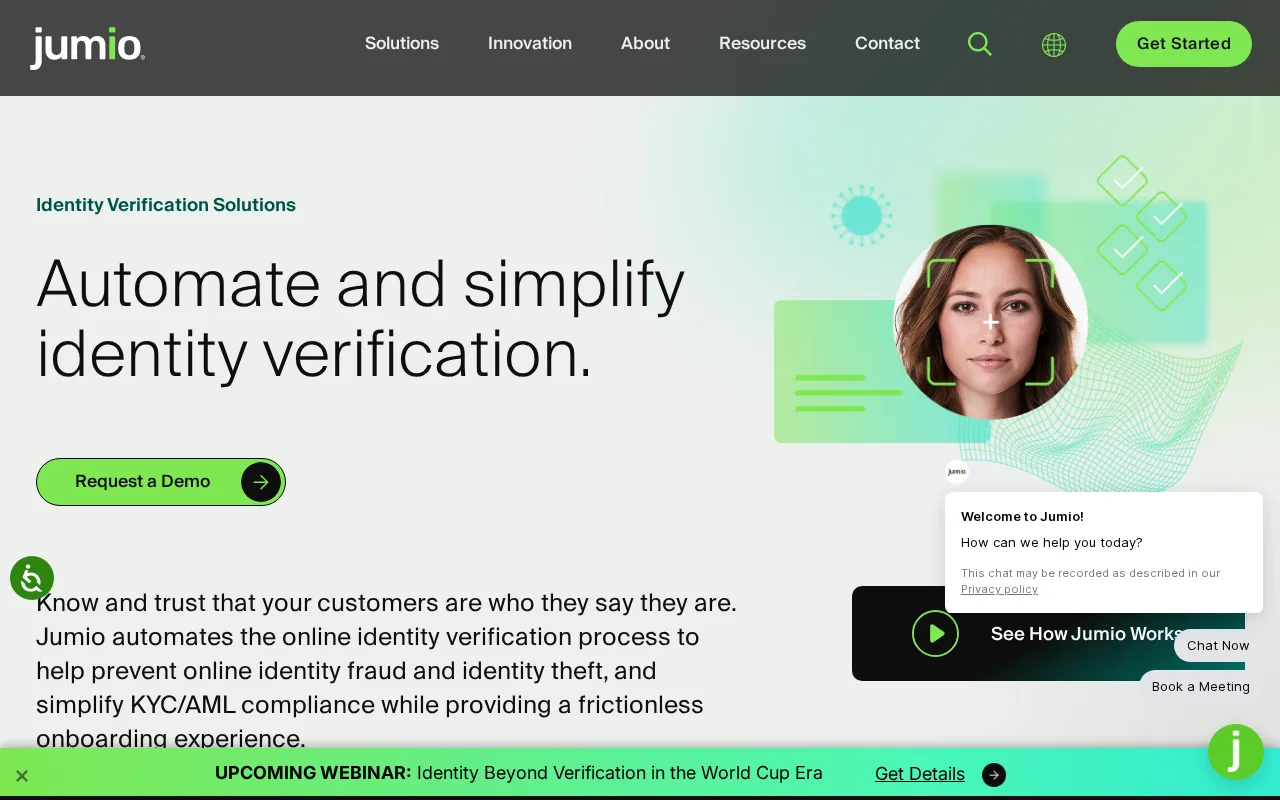
- Jumio Identity Verification authenticates government-issued IDs and matches user selfies to prevent fraud.
- How much does it cost?
- Pricing is based on usage and requires contacting Jumio sales for detailed quotes.
- Does it have a free plan?
- Yes, a free plan is available with limited verifications for testing purposes.
- What integrations does it support?
- Jumio offers SDKs and cloud-based solutions but does not publicly list specific integrations.
- Who is it best for?
- It is best suited for enterprises and regulated businesses needing robust identity verification.
- What is this tool?
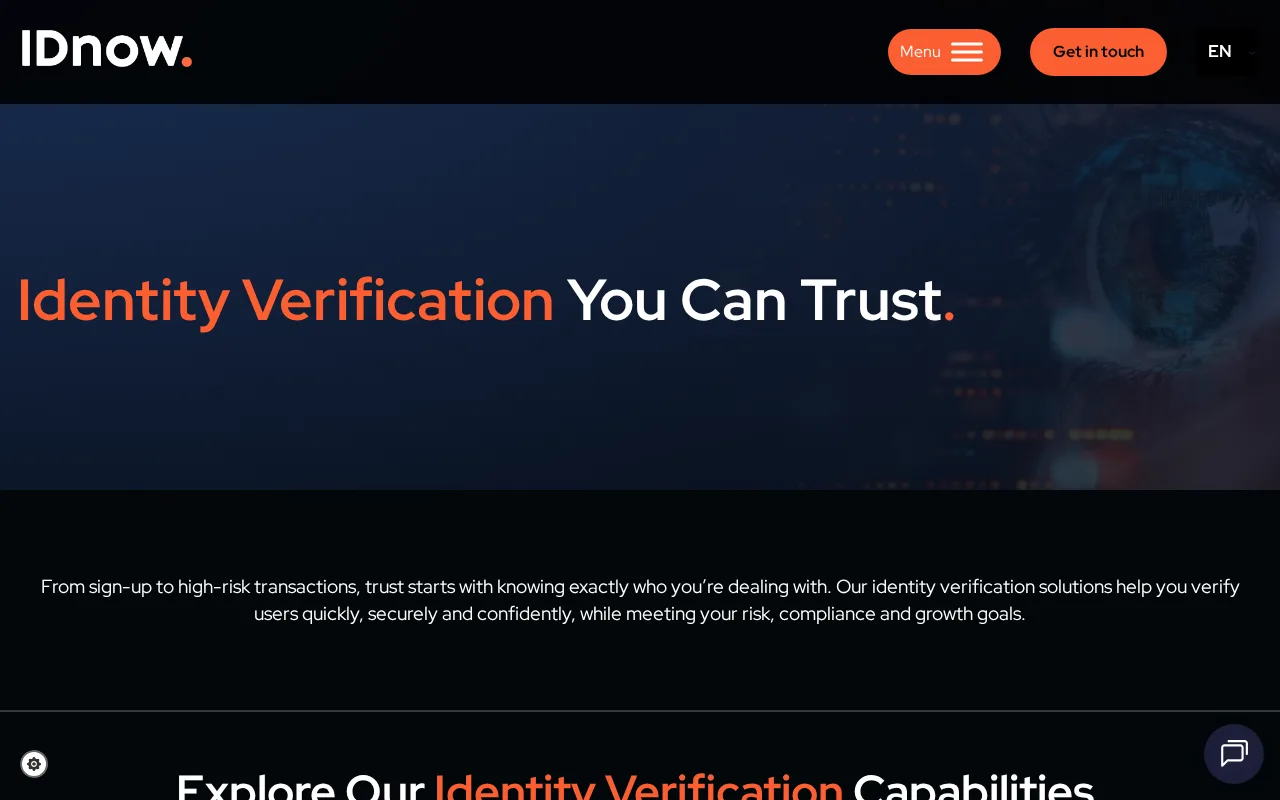
- IDnow AutoIdent automates identity verification using video and AI-based face recognition to ensure secure onboarding.
- How much does it cost?
- Pricing details are not publicly disclosed; a freemium plan is available with basic features.
- Does it have a free plan?
- Yes, a free plan with limited features is available for basic identity verification.
- What integrations does it support?
- Specific integrations are not publicly detailed; it is primarily offered as a cloud service.
- Who is it best for?
- Best for enterprises and regulated businesses needing compliant, automated identity verification.
| Info | Jumio Identity Verification | IDnow AutoIdent |
|---|---|---|
| Pricing | Freemium | Freemium |
| Category | Finance, Banking & Fintech AI | Finance, Banking & Fintech AI |
| Deployment | Cloud | Cloud |
| Learning Curve | Intermediate | Intermediate |
| Free Plan | ✓ | ✓ |
| AI Agent | ✓ | ✗ |
| Autonomy | Assistant | Copilot |
| Risk Tier | High | Medium |
 Shufti Pro
 SentiLink Platform
 BlinkID
 Smile Identity
 Veriff
 FaceCheck ID
IDnow AutoIdent and Jumio Identity Verification both offer freemium pricing models and have similar overall scores, 5.5/10 and 5.6/10 respectively. IDnow AutoIdent focuses on automated identity verification with strong support for European regulatory compliance, making it suitable for industries requiring strict KYC processes. Jumio Identity Verification provides a broader range of identity verification features, including biometric authentication and document verification, catering to global use cases across various sectors such as finance, travel, and retail.
ⓘ How Volvenix scores work
Scores are computed by Volvenix — not supplied by the vendors, and not third-party benchmark results. Each 0–10 dimension (Overall, Features, Usability, Support, Pricing) is a directional estimate aggregated from catalog signals — editorial cataloguing, content depth, engagement, and provider-reputation indicators — so treat them as a starting point, not a lab result.
Confidence reflects how complete the underlying data is for both tools; lower confidence means fewer signals were available, not a worse tool. We never accept payment for rankings or scores. More about how Volvenix works →