 Volvenix
Photoleap by Lightricks vs Luminar Neo
AI-enhanced independent comparison — features, pros, cons, pricing and rankings.
 ChatGPT
  Claude
  Gemini
  Midjourney
  DALL-E
  Stable Diffusion
  Notion AI
  Canva
Canva  Grammarly
  GitHub Copilot
  ElevenLabs
  Perplexity
  Runway
  Synthesia
  Fireflies.ai
  Hugging Face Hub
| Dimension | Photoleap by Lightricks | Luminar Neo |
|---|---|---|
| Accuracy & Reliability | — | |
| Ease of Use | — | |
| Features & Capability | — | |
| Value for Money | — | |
| Performance & Speed | — | |
| Popularity & Adoption | — |
Who each tool serves best — and when to pick the other one.
Photographers, digital artists, and content creators who want powerful layering and AI editing on mobile and web platforms.
- You want to edit photos with advanced layering and blending on mobile or web easily.
- You need AI-powered tools to enhance and creatively manipulate images.
- Your workflow requires a flexible app that works across devices for photo editing.
Users needing full desktop-class professional editing suites or those requiring extensive batch processing and automation.
- You need a full professional desktop photo editor with extensive batch processing.
- Free-tier limitations prevent you from accessing essential advanced editing features.
- You require deep automation or integration with enterprise workflows.
The tool’s combination of layering capabilities with AI-powered editing on mobile and web platforms.
Photographers and creative professionals who want to speed up photo editing with AI tools while maintaining creative flexibility.
- You want to automate complex photo edits like background removal quickly and easily.
- You need a user-friendly tool that balances AI automation with manual creative control.
- Your workflow requires modular AI tools for flexible photo enhancements.
Users needing highly specialized or advanced manual editing controls or those requiring extensive plugin ecosystems.
- You require deep, professional-grade manual editing features beyond AI automation.
- Free-tier limitations prevent you from accessing essential editing tools.
- You depend heavily on third-party plugin integrations not supported by Luminar Neo.
The effectiveness and ease of use of its AI-powered background removal and image enhancement tools.
A canonical comparison across capabilities common to this category. Vendor-specific extras appear below in "Highlighted Features".
| Capability | Photoleap by Lightricks | Luminar Neo |
|---|---|---|
|
Free Tier Available
Usable without payment (with usage limits)
|
✓ | ✓ |
Each tool's marketing-listed features. Where a feature appears under one tool but not the other, it usually reflects how the vendor describes their product — not a definitive capability gap.
- Layering and Blending — Supports multiple layers with blending modes
- AI-Powered Enhancements — Automatic photo corrections and creative effects
- Mobile and Web Access — Available on iOS and web browsers
- Premium Effects — Exclusive filters and effects for paid users
- Team collaboration — Shared projects and team workflows
- Background Removal — AI-powered automatic background removal
- Relighting — Adjust lighting on photos with AI
- RAW Support — Edit RAW image files natively
- Layers and Masks — Advanced compositing with layers and masks
- Sky Replacement — Replace skies with AI-assisted tools
- User-friendly layering and blending interface
- Strong AI-powered editing tools
- Cross-platform mobile and web access
- Good for creative photo manipulation
- Regular updates and improvements
- Accurate and fast AI background removal
- User-friendly interface with modular AI tools
- Supports RAW and high-resolution images
- Regular updates with new AI features
- Good value with freemium pricing
- Advanced features require paid subscription
- Limited batch processing capabilities
- No public API available
- Lacks some advanced manual editing controls
- No mobile app available
- Limited third-party plugin support
- Creative photo editing with layering
- Enhancing images using AI tools
- Mobile photo manipulation on the go
- Digital art creation and blending
- Collaborative editing for small teams
- Portrait photo editing and enhancement
- Background removal for product photography
- Creative photo relighting and effects
- Batch editing for photographers
- Social media content creation
Natural languages each tool generates and understands. Primary languages are listed first.
What each tool can accept (input) and produce (output) — text, image, audio, video, code.
Offers a free tier with basic features and paid subscriptions unlocking advanced tools and effects.
-
Free
Free -
Pro
popular
$20.00/mo -
Team
$30.00/mo
Offers a free plan with basic features and paid subscriptions for full access and advanced tools.
-
Free
Free -
Pro
popular
$11.99/mo
Regulatory frameworks each tool claims compliance with (HIPAA, SOC 2, GDPR, etc.).
Vendor-published numbers each tool highlights — usage scale, breadth, and operational stats. Different tools track different metrics, so direct row-by-row comparison usually isn't meaningful.
- User base Millions of downloads
- Time saved per edit 30% percent
Who each tool is positioned for — primary audience first.
How you can reach support — email, live chat, phone, community, docs.
- Documentation primary
- Documentation primary visit ↗
How each tool is classified in the Volvenix catalog.
These vocabulary domains are managed in our catalog but not yet exposed at the tool level. We're tracking them for future expansion of this comparison.
- Encryption Types — AES-256, ChaCha20, RSA-2048, and similar at-rest/in-transit cipher families.
- Encryption Contexts — where encryption is applied (data at rest, in transit, end-to-end).
- Plan-tier Model Mapping — which AI models are available on which pricing tier (currently only the model list is tracked, not the per-plan availability).
No screenshots uploaded yet.
- What is this tool?
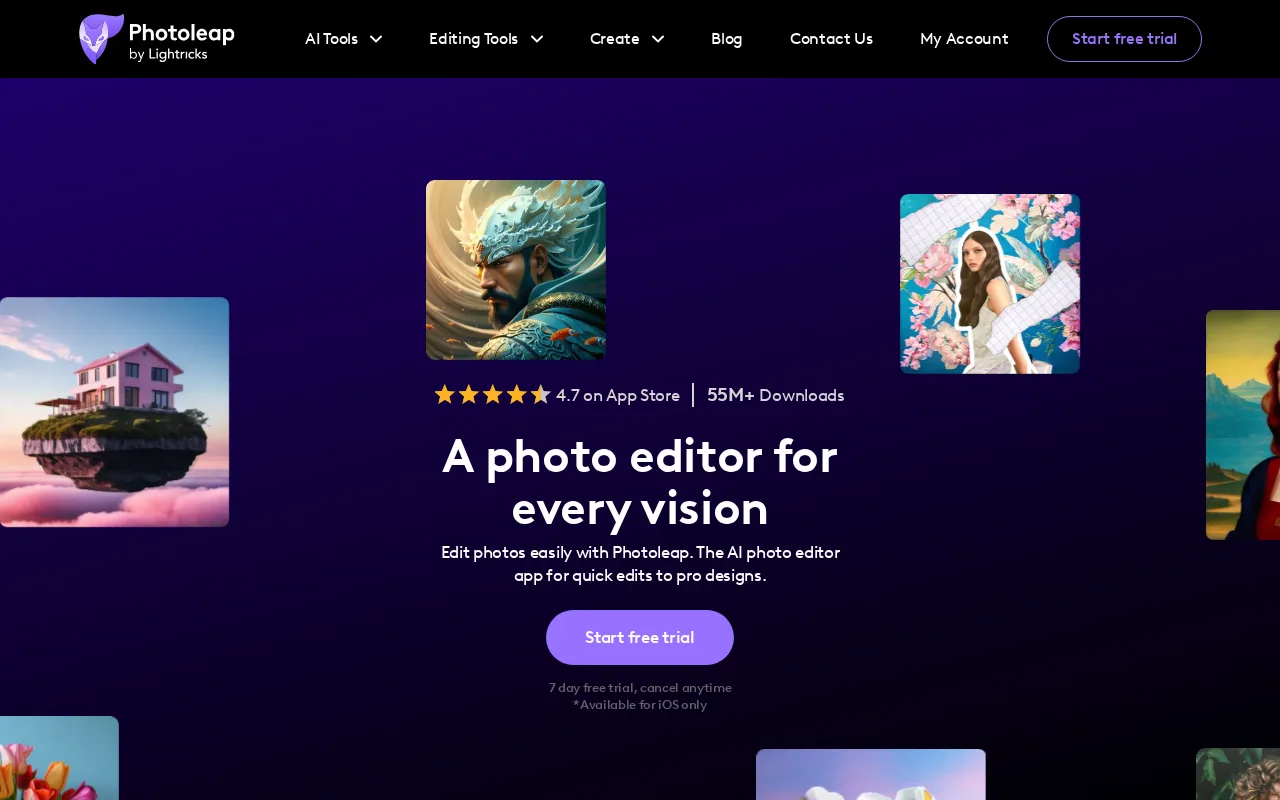
- Photoleap is a mobile and web app for photo editing with layering and AI-powered enhancements.
- How much does it cost?
- Photoleap offers a free tier and paid subscriptions starting at $20/month for advanced features.
- Does it have a free plan?
- Yes, there is a free plan with basic editing tools and limited features.
- What integrations does it support?
- Photoleap does not currently offer native integrations or a public API.
- Who is it best for?
- It is best suited for photographers and digital artists seeking intuitive layering and AI editing on mobile and web.
- What is this tool?
- Luminar Neo is an AI-powered photo editing software focused on automating complex edits like background removal.
- How much does it cost?
- Luminar Neo offers a free plan with basic features and a paid Pro subscription for full access starting at $11.99/month.
- Does it have a free plan?
- Yes, Luminar Neo provides a free plan with limited features for individual users.
- What integrations does it support?
- Luminar Neo primarily functions as standalone desktop software with no major third-party integrations.
- Who is it best for?
- It is best suited for photographers and creatives seeking AI-assisted photo editing with easy-to-use tools.
| Info | Photoleap by Lightricks | Luminar Neo |
|---|---|---|
| Pricing | Freemium | Freemium |
| Category | AI Image Generation | AI Image Generation |
| Deployment | Cloud | Desktop |
| Learning Curve | Intermediate | Beginner |
| Free Plan | ✓ | ✓ |
| AI Agent | ✗ | ✗ |
| Autonomy | Copilot | Copilot |
| Risk Tier | Medium | Medium |
 Pixian.ai
 Polarr AI Photo Editor
 FaceApp
 InPixio Photo Studio AI
Luminar Neo and Photoleap by Lightricks both offer freemium pricing models, allowing users to access basic features for free with optional paid upgrades. Luminar Neo, with an overall score of 5.1/10, focuses primarily on AI-driven photo editing and enhancement tools suited for photographers looking to automate complex edits. Photoleap by Lightricks, scoring slightly higher at 5.4/10, combines photo editing with creative design features, targeting users interested in both image manipulation and artistic composition.
ⓘ How Volvenix scores work
Scores are computed by Volvenix — not supplied by the vendors, and not third-party benchmark results. Each 0–10 dimension (Overall, Features, Usability, Support, Pricing) is a directional estimate aggregated from catalog signals — editorial cataloguing, content depth, engagement, and provider-reputation indicators — so treat them as a starting point, not a lab result.
Confidence reflects how complete the underlying data is for both tools; lower confidence means fewer signals were available, not a worse tool. We never accept payment for rankings or scores. More about how Volvenix works →