 Volvenix
Qiskit vs QuEra Quantum Hardware Simulator
AI-enhanced independent comparison — features, pros, cons, pricing and rankings.
 ChatGPT
  Claude
  Gemini
  Midjourney
  DALL-E
  Stable Diffusion
  Notion AI
  Canva
Canva  Grammarly
  GitHub Copilot
  ElevenLabs
  Perplexity
  Runway
  Synthesia
  Fireflies.ai
  Hugging Face Hub

| Dimension | Qiskit | QuEra Quantum Hardware Simulator |
|---|---|---|
| Accuracy & Reliability | ||
| Ease of Use | ||
| Features & Capability | ||
| Value for Money | ||
| Performance & Speed | ||
| Popularity & Adoption |
Who each tool serves best — and when to pick the other one.
Researchers, developers, and educators focused on quantum computing algorithm development and experimentation.
- You want to develop and test quantum algorithms using Python and IBM quantum devices.
- You need an open-source framework with access to real quantum hardware and simulators.
- Your team requires a modular toolkit for quantum software research and education.
Users seeking turnkey quantum solutions or those without programming experience may find Qiskit challenging.
- You need a no-code or low-code quantum computing solution for business use.
- Free-tier limits are a blocker for your quantum computing experiments at scale.
- You require extensive commercial support or turnkey quantum applications.
Access to IBM quantum hardware and a strong open-source Python SDK for quantum algorithm development.
Researchers and developers working on neutral atom quantum computing algorithms and hardware design simulations.
- You need to simulate neutral atom quantum hardware for algorithm testing and design.
- You want a platform tailored to experimental and theoretical quantum research.
- Your team requires realistic quantum system modeling specific to neutral atom processors.
Users seeking general-purpose quantum simulators or those focused on other quantum hardware types like superconducting qubits.
- You need a broad quantum simulator supporting multiple qubit technologies.
- Free-tier limits are a blocker for your advanced simulation needs.
- You require extensive integrations with common SaaS or developer tools.
Focus on neutral atom quantum hardware simulation accuracy and research applicability.
A canonical comparison across capabilities common to this category. Vendor-specific extras appear below in "Highlighted Features".
| Capability | Qiskit | QuEra Quantum Hardware Simulator |
|---|---|---|
|
Free Tier Available
Usable without payment (with usage limits)
|
✓ | ✓ |
Each tool's marketing-listed features. Where a feature appears under one tool but not the other, it usually reflects how the vendor describes their product — not a definitive capability gap.
- Quantum Circuit Design — Create and manipulate quantum circuits using Python
- Quantum Hardware Access — Run algorithms on IBM quantum processors
- Quantum Simulators — Simulate quantum circuits locally or in the cloud
- Visualization tools — Visualize quantum circuits and results
- Algorithm Libraries — Pre-built algorithms for chemistry, optimization, and AI
- Neutral Atom Quantum Hardware Simulation — Simulates behavior of neutral atom quantum processors
- Algorithm Testing — Enables testing of quantum algorithms on simulated hardware
- Experimental and Theoretical Support — Supports both experimental setups and theoretical modeling
- Collaboration Features — Available in paid plans for team access
- Cloud-based access — Accessible via web platform without local installation
- Open-source with extensive documentation and tutorials
- Direct access to IBM quantum hardware and simulators
- Modular and extensible Python SDK
- Strong community and IBM support
- Suitable for education and research
- Specialized neutral atom quantum hardware simulation
- Supports experimental and theoretical quantum research
- Accessible freemium pricing model
- Steep learning curve for new quantum computing users
- Limited practical use cases without access to quantum hardware
- No official mobile app or offline deployment
- Limited to neutral atom quantum hardware simulation
- No public API or integrations available
- Quantum algorithm research and development
- Educational quantum computing courses
- Simulating quantum circuits
- Testing quantum software on real hardware
- Developing quantum chemistry applications
- Testing quantum algorithms on neutral atom hardware models
- Simulating quantum hardware designs for research
- Validating experimental quantum processor setups
- Educational use in quantum computing courses
- Developing quantum software compatible with neutral atom systems
Natural languages each tool generates and understands. Primary languages are listed first.
What each tool can accept (input) and produce (output) — text, image, audio, video, code.
Qiskit is free and open-source; access to IBM quantum hardware includes free tiers with usage limits and paid options for higher usage.
-
Free
Free
Offers a free tier with basic simulation features and paid plans for enhanced capabilities and team access.
-
Free
Free
Third-party audits and certifications that verify security controls.
No certifications listed.
Who each tool is positioned for — primary audience first.
How you can reach support — email, live chat, phone, community, docs.
- Documentation primary visit ↗
- Documentation primary
How each tool is classified in the Volvenix catalog.
These vocabulary domains are managed in our catalog but not yet exposed at the tool level. We're tracking them for future expansion of this comparison.
- Encryption Types — AES-256, ChaCha20, RSA-2048, and similar at-rest/in-transit cipher families.
- Encryption Contexts — where encryption is applied (data at rest, in transit, end-to-end).
- Plan-tier Model Mapping — which AI models are available on which pricing tier (currently only the model list is tracked, not the per-plan availability).
- What is this tool?
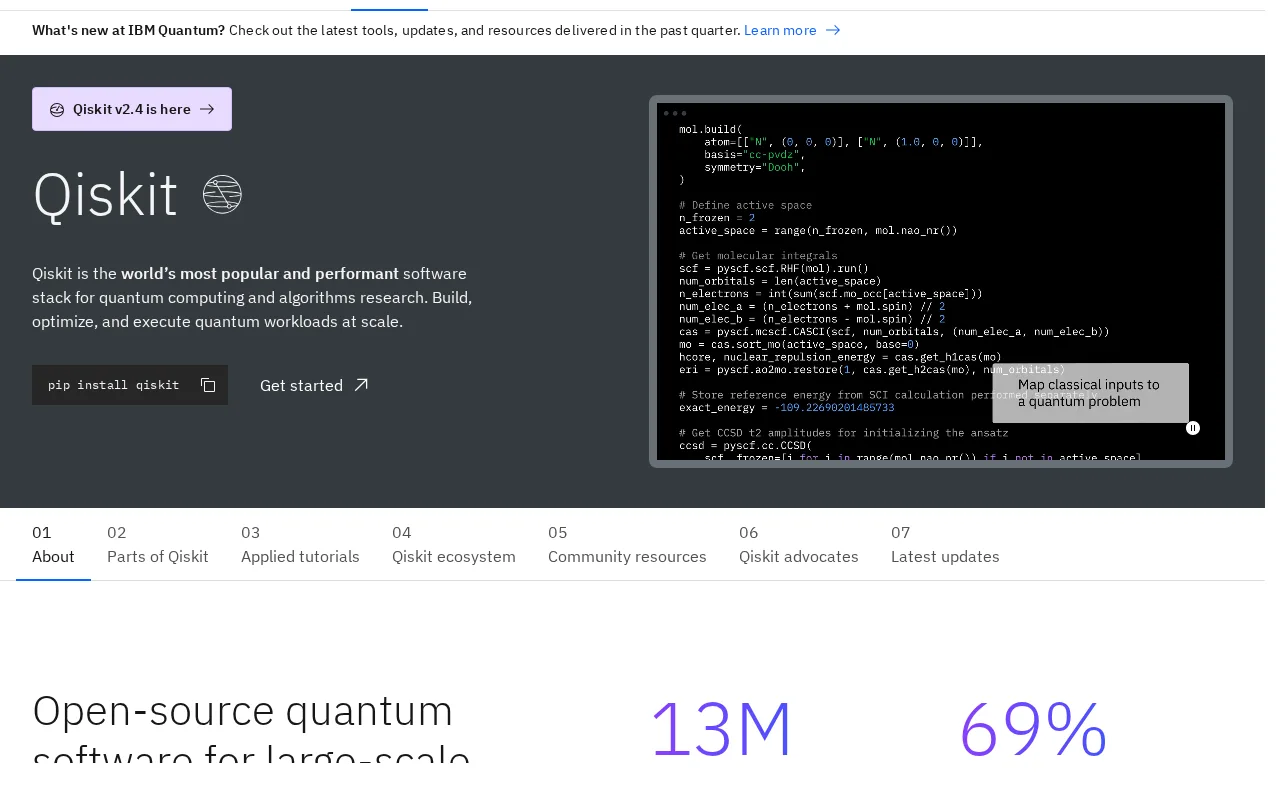
- Qiskit is an open-source Python framework for developing and running quantum computing algorithms on simulators and IBM quantum hardware.
- How much does it cost?
- Qiskit is free to use; access to IBM quantum hardware includes free tiers with usage limits and paid options for higher usage.
- Does it have a free plan?
- Yes, Qiskit is free and open-source with free access to simulators and limited IBM quantum hardware.
- What integrations does it support?
- Qiskit integrates primarily with IBM quantum hardware and supports Python-based development environments.
- Who is it best for?
- Qiskit is best for researchers, developers, and educators working on quantum computing algorithms and experiments.
- What is this tool?
- QuEra Quantum Hardware Simulator simulates neutral atom quantum processors to test algorithms and hardware designs.
- How much does it cost?
- It offers a free tier with basic features; paid plans provide enhanced capabilities.
- Does it have a free plan?
- Yes, a free plan is available for individual users with basic simulation features.
- What integrations does it support?
- No public integrations or APIs are currently available.
- Who is it best for?
- Researchers and developers focused on neutral atom quantum computing hardware and algorithm simulation.
Qiskit SDK
—
| Info | Qiskit | QuEra Quantum Hardware Simulator |
|---|---|---|
| Pricing | Freemium | Freemium |
| Category | Quantum, Neuromorphic & Next-Gen AI Hardware | Quantum, Neuromorphic & Next-Gen AI Hardware |
| Deployment | Cloud | Cloud |
| Learning Curve | Advanced | Advanced |
| Free Plan | ✓ | ✓ |
| AI Agent | ✓ | ✗ |
| Autonomy | Assistant | Assistant |
| Risk Tier | Low | Low |
 Classiq Quantum Algorithm Design Platform
 IonQ
IonQ Xanadu PennyLane
 Quantum Inspire
QuEra Quantum Hardware Simulator and Qiskit both offer freemium pricing models, with overall scores of 5.3/10 and 5.5/10 respectively. QuEra focuses on simulating quantum hardware with an emphasis on specific quantum architectures, while Qiskit provides a broader open-source framework for quantum programming and experimentation across multiple quantum devices. Their feature sets and use cases differ primarily in scope, with QuEra tailored more toward hardware simulation and Qiskit supporting a wide range of quantum algorithm development and execution.
ⓘ How Volvenix scores work
Scores are computed by Volvenix — not supplied by the vendors, and not third-party benchmark results. Each 0–10 dimension (Overall, Features, Usability, Support, Pricing) is a directional estimate aggregated from catalog signals — editorial cataloguing, content depth, engagement, and provider-reputation indicators — so treat them as a starting point, not a lab result.
Confidence reflects how complete the underlying data is for both tools; lower confidence means fewer signals were available, not a worse tool. We never accept payment for rankings or scores. More about how Volvenix works →