
Qdrant logo
Rank #685
NEURAL SEARCH FREEMIUM CLOUD #3 in Neural Search

Qdrant Review — High-Dimensional Vector Search

Qdrant offers real-time vector search with flexible APIs for developers and data scientists.
19 monthly visitors 32K GitHub stars 19 page views (30d)
Reviewed by Volvenix Editorial
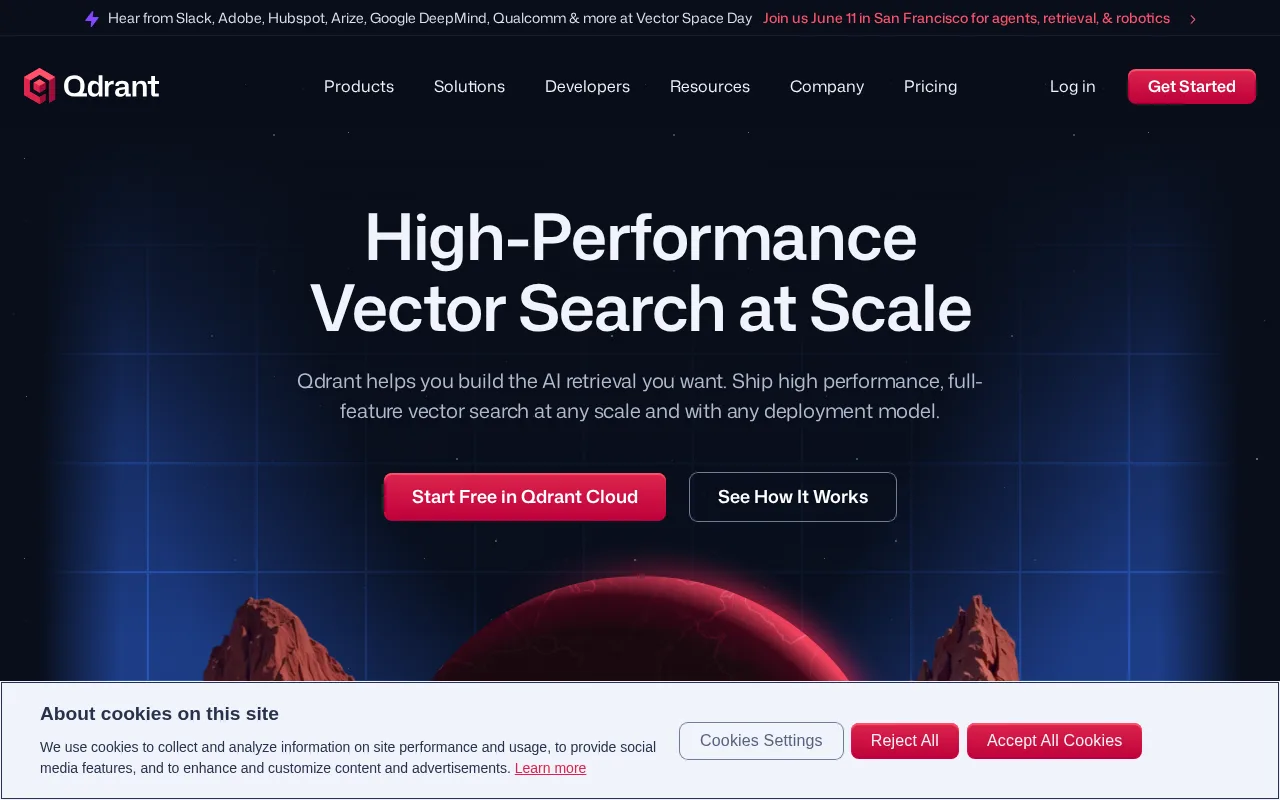
Qdrant — preview
8.0
Volvenix Verdict
AI-powered editorial review
Qdrant
A robust, open-source vector search engine ideal for scalable semantic search and recommendations.
PROS
  • Open-source with active community
  • Real-time vector updates
  • Flexible API and deployment
  • Optimized for high-dimensional search
  • Strong for recommendation and semantic search
CONS
  • Requires technical expertise to deploy and manage
  • Limited out-of-the-box SaaS integrations

Is Qdrant Right for You?

A quick checklist to help you decide.

You need to implement real-time vector search for semantic or recommendation apps.
You need a fully managed, no-code search platform with minimal setup.
You want an open-source solution with flexible deployment options.
Free-tier limits are a blocker for your production-scale use.
Your team requires scalable high-dimensional search with API access.
You require extensive third-party SaaS integrations out of the box.

Ideal for: Developers and data scientists building scalable semantic search or recommendation systems needing real-time vector search.

Less suited for: Non-technical users or teams seeking turnkey search solutions without managing infrastructure or APIs.

Bottom line: The need for scalable, real-time high-dimensional vector search with flexible deployment.

Editorial Review AI-generated
Qdrant excels in delivering fast, scalable vector search with real-time update capabilities, making it a strong choice for semantic search and recommendation systems. Its open-source model and flexible deployment options provide versatility for various use cases. However, it requires some technical expertise to deploy and optimize, which may limit accessibility for non-technical users. The API is well-documented but lacks some advanced integrations found in commercial alternatives. Overall, it is best suited for developers and data scientists focused on neural search applications.

AI-assessed from 4 sources.

Pros & Cons

Pros

Open-source with active development
Supports real-time vector updates
Flexible API for integration
Scalable for high-dimensional data
Good documentation and community

Cons

Requires technical knowledge to deploy and maintain moderate
Workaround: Use managed cloud service or consult community resources
Limited native SaaS integrations minor
Who Is It For & What Can It Do
Best For
Developer / Engineer Data Scientist / Analyst Product Manager Intermediate curve
AI Capabilities
Search
Key Features
Real-time Vector Search
Supports fast updates and queries on high-dimensional vectors
Flexible API
REST and gRPC APIs for easy integration
Open-Source
Fully open-source under Apache 2.0 license
Cloud Hosting
Managed cloud service available
Scalability
Handles billions of vectors efficiently
Best Use Cases
Semantic search engines Recommendation systems Image and video similarity search Anomaly detection in vector data Natural language processing embeddings
Available Platforms
Cloud
Inputs & Outputs
Apiinput Apioutput
Supported Languages
English
Security & Compliance
Certifications
SOC 2 Type II
AICPA
ISO 27001
ISO
GDPR
European Union
Compliance Standards
GDPR
Privacy · EU
Pricing Plans

Free

Open-source self-hosted

Free
 
  • Core vector search engine
  • Community support

Qdrant offers a free open-source version and a freemium cloud service with usage-based pricing tiers.

Price Range
Free $0–$0
Support Channels
More from Qdrant
Did you find this page helpful?
Frequently Asked Questions
What is this tool?
Qdrant is an open-source vector search engine optimized for real-time, high-dimensional vector search.
How much does it cost?
Qdrant is free to self-host; managed cloud pricing is usage-based with a freemium tier.
Does it have a free plan?
Yes, the open-source version is free to use and self-host.
What integrations does it support?
Qdrant provides REST and gRPC APIs; no native third-party SaaS integrations are currently offered.
Who is it best for?
Developers and data scientists needing scalable, real-time vector search for semantic or recommendation applications.
User Reviews

No reviews yet. Be the first to review Qdrant!

Write a Review
Discussion
No discussions yet. Start the conversation!
0 tools selected
Compare Now →
Qdrant Visit Tool