
Ray logo
Rank #220
AI TRAINING FREEMIUM SELF HOSTED #7 in AI Training

Ray Review — Model training scalability

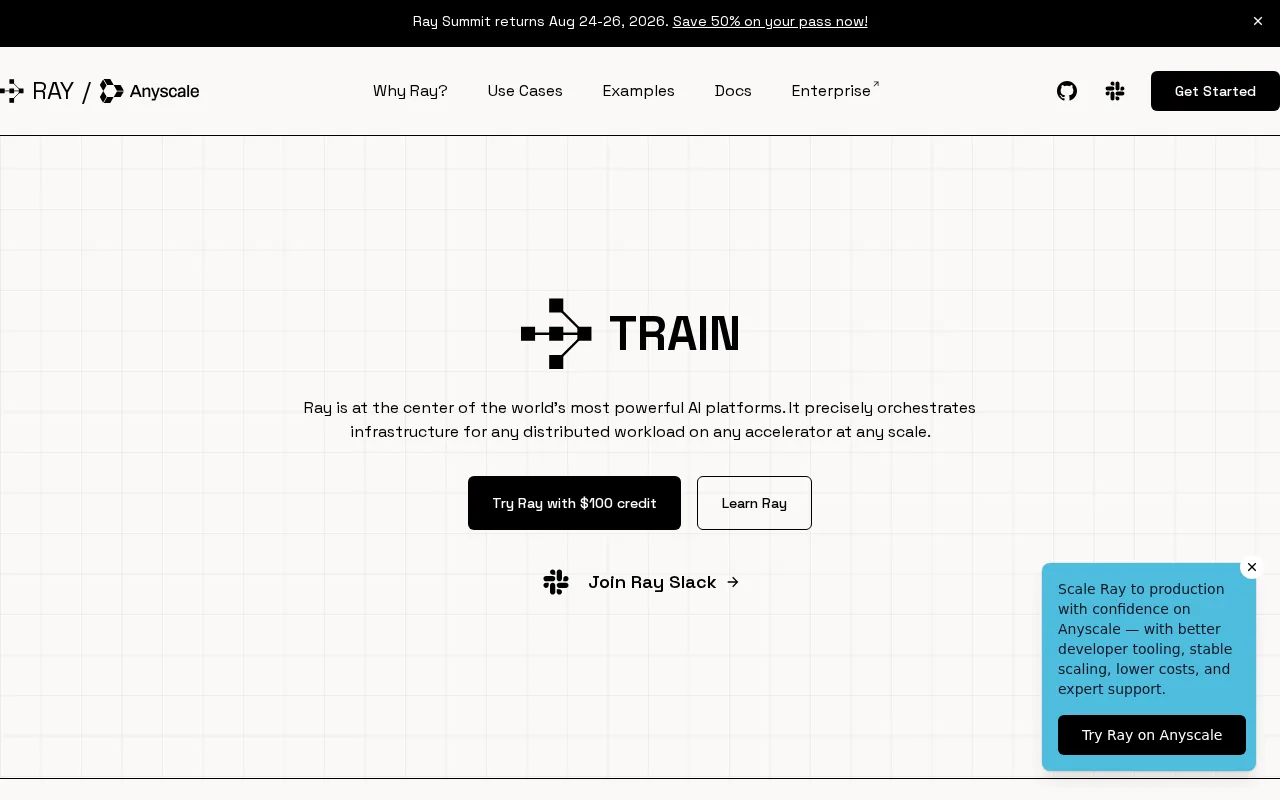
Ray is an open-source framework for distributed computing and model training at scale.
7.1 / 10
Visit Ray
5 monthly visitors 5 page views (30d)
Reviewed by Volvenix Editorial
8.0
Volvenix Verdict
AI-powered editorial review
Ray
Ray is a powerful open-source platform ideal for scalable ML training and distributed data workloads.
PROS
  • Open-source with strong community support
  • Flexible APIs for distributed task and actor programming
  • Scales efficiently across clusters
  • Supports ML training, hyperparameter tuning, and experiment tracking
CONS
  • Steep learning curve for beginners
  • Limited turnkey SaaS features and integrations

Is Ray Right for You?

A quick checklist to help you decide.

You need to run large-scale distributed ML training or data processing in Python.
You need a fully managed SaaS MLOps platform with minimal setup.
You want fine-grained control over distributed task execution and resource management.
Free-tier limits are a blocker for your production workloads.
Your team requires an open-source, extensible platform for custom ML pipelines.
You require native support for non-Python languages or turnkey integrations.

Ideal for: Data scientists and engineers building scalable ML training pipelines and distributed data workflows.

Less suited for: Users seeking turnkey SaaS MLOps platforms or those without Python/distributed computing experience.

Bottom line: Ability to scale Python workloads seamlessly across clusters with flexible distributed APIs.

Editorial Review AI-generated
Ray excels at simplifying distributed computing for Python applications, especially in machine learning and data engineering. Its flexible APIs and actor model allow efficient scaling across clusters, making it suitable for complex pipelines and experiment tracking. However, it requires some expertise to set up and optimize, which may challenge beginners. Ray is best suited for teams needing custom distributed workflows rather than plug-and-play solutions.
Pros & Cons

Pros

Open-source with active community
Highly scalable distributed computing
Flexible task and actor APIs
Supports ML experiment tracking
Integrates with popular ML frameworks

Cons

Steep learning curve for new users moderate
Workaround: Use official tutorials and community resources
Limited turnkey SaaS features moderate
Primarily Python-focused minor
Who Is It For & What Can It Do
Best For
Developer / Engineer Data Scientist / Analyst Product Manager Advanced curve
AI Capabilities
Code Execution Distributed Task Execution Experiment Tracking Model Training Tool Calling
Key Features
Distributed Task Execution
Run Python tasks in parallel across clusters
Actor Model
Stateful distributed actors for complex workflows
Hyperparameter tuning
Built-in support for scalable tuning with Ray Tune
Experiment tracking
Track ML experiments and results
Managed Cloud Service
Optional commercial managed Ray clusters
Best Use Cases
Distributed machine learning training Hyperparameter tuning at scale Building scalable data processing pipelines Experiment tracking for ML workflows Running parallel Python workloads
Available Platforms
Inputs & Outputs
Codeinput Codeoutput
Supported Languages
English
Security & Compliance
API & Developer Tools
Pricing Plans

Free

Open-source core framework

Free
 
  • Distributed computing APIs
  • Basic ML training and tuning support

Ray is open-source and free to use; commercial offerings provide additional managed services and enterprise features.

Price Range
Free $0–$0
Support Channels
Did you find this page helpful?
Frequently Asked Questions
What is this tool?
Ray is an open-source framework for distributed computing and scalable machine learning training in Python.
How much does it cost?
Ray's core framework is free and open-source; commercial managed services have separate pricing.
Does it have a free plan?
Yes, the open-source Ray framework is free to use without restrictions.
What integrations does it support?
Ray integrates with ML frameworks like TensorFlow, PyTorch, and supports libraries like Ray Tune and RLlib.
Who is it best for?
Ray is best for data scientists and engineers needing scalable distributed ML training and custom pipelines.
User Reviews

No reviews yet. Be the first to review Ray!

Write a Review
Discussion
No discussions yet. Start the conversation!
0 tools selected
Compare Now →
Ray Visit Tool